Market microstructure / Simulation
Adverse Selection Lab
What happens to a market maker when the trader on the other side knows more?
The experiment
I built a synthetic market with one dealer, informed traders, and noise traders. Three quoting strategies face the same seeded scenarios, so their differences can be compared directly. The experiments vary informed order flow, volatility, spreads, and signal quality to study how each changes the dealer’s profit and risk.
Selected results
What the simulations show
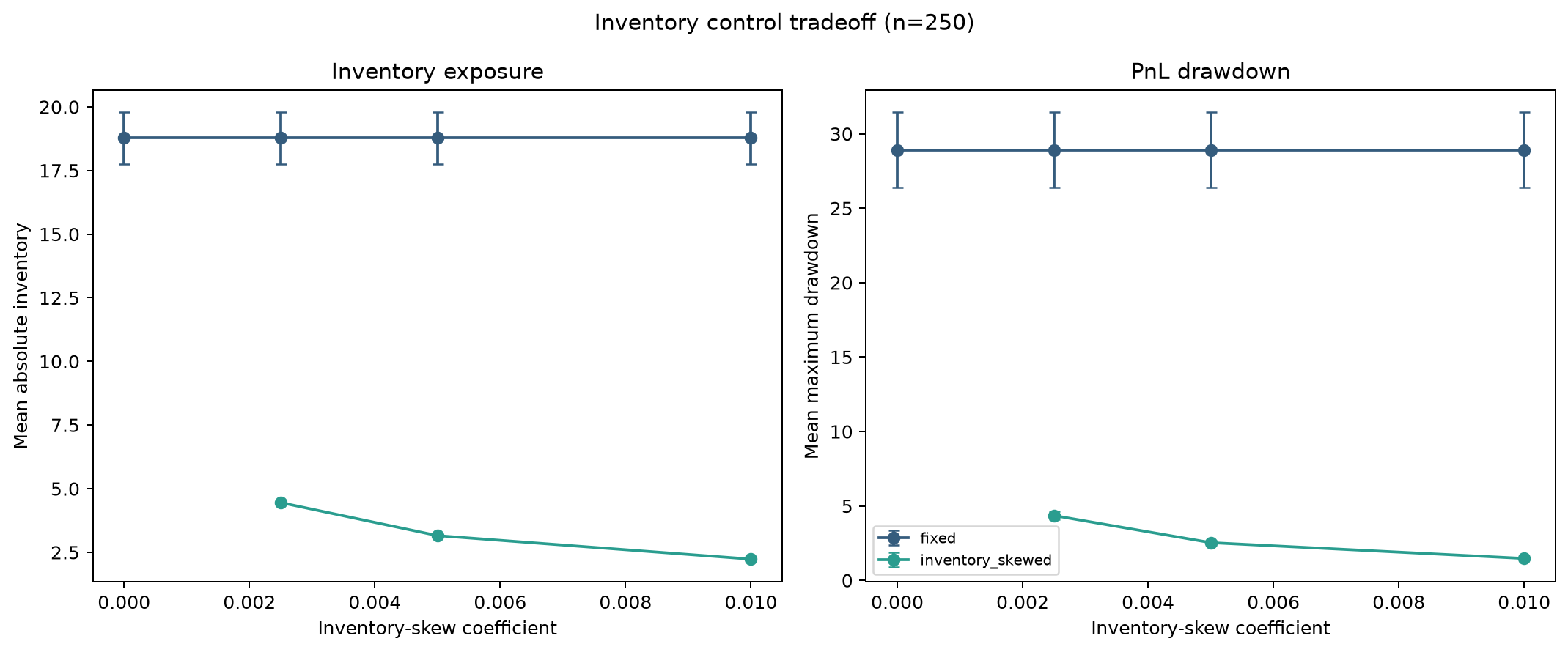
Inventory control reduces risk.
Shifting quotes in response to inventory reduced exposure and drawdown in these experiments. The paired comparisons did not establish a statistically conclusive improvement in profit.
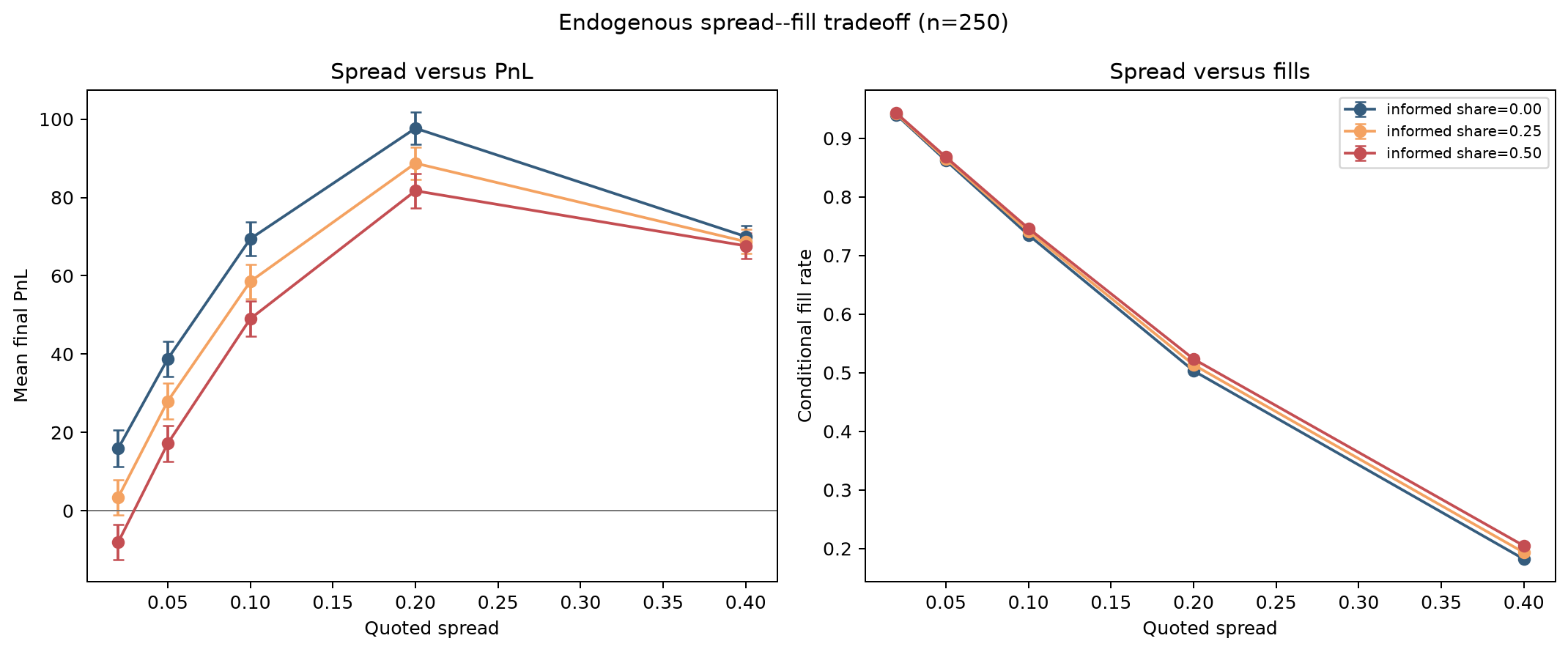
A wider spread comes with a tradeoff.
Quoting farther from fair value changes the profit per trade, but fewer traders accept the quote. The spread sweep tracks fill rates alongside total profit and adverse-selection losses.
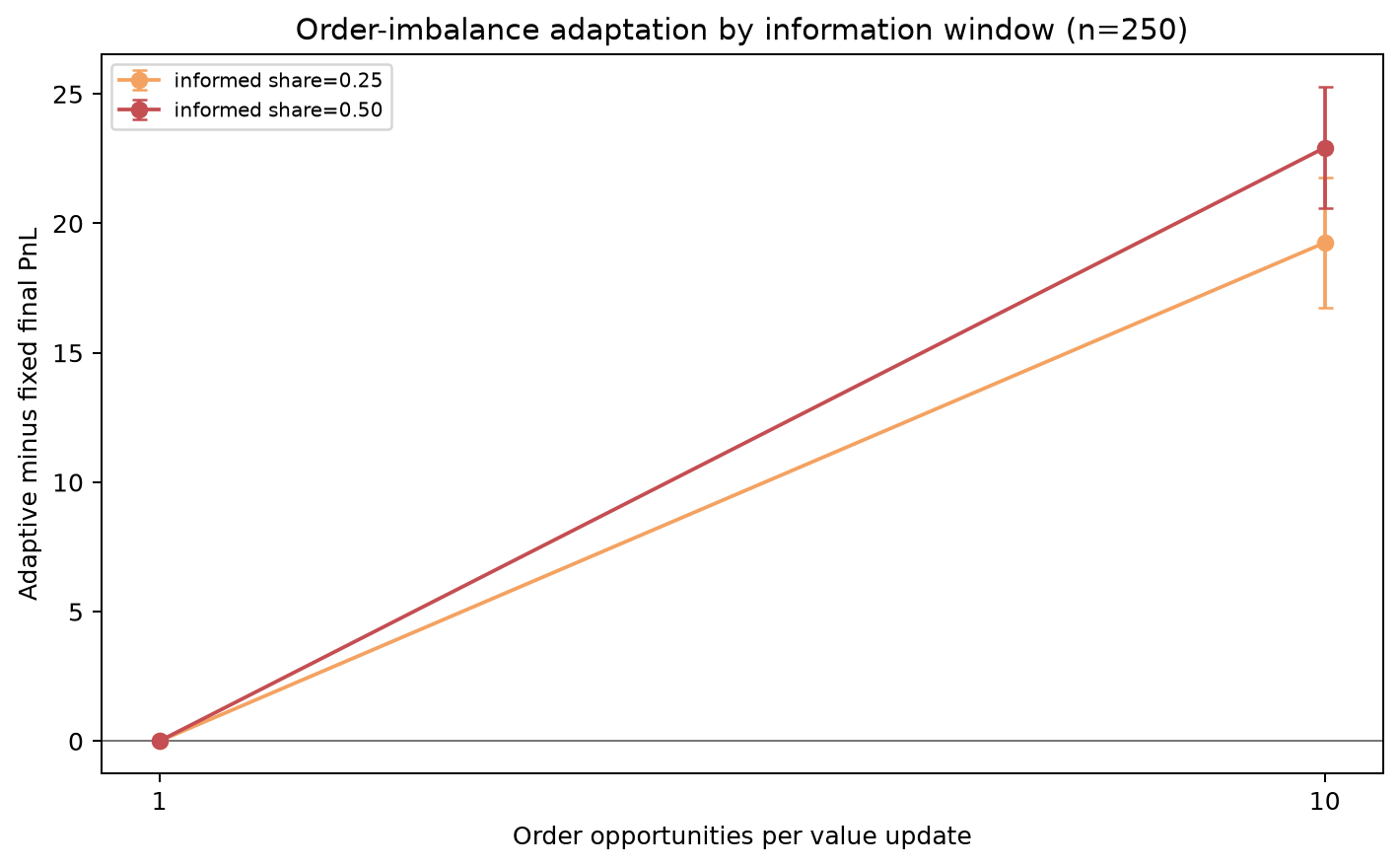
Adapting to order flow needs informative history.
Toxicity-adaptive quotes improved simulated profit when clustered trading made earlier fills informative. With one order opportunity per interval, there was no earlier same-interval fill to learn from, and the adaptive strategy matched the fixed strategy.
Scope & limitations
A controlled model of a market.
These experiments isolate mechanisms in a fully synthetic setting. The model uses one dealer, one-unit trades, Gaussian shocks, and an observed current efficient value. It omits competing makers, queue position, cancellations, partial fills, fees, latency, and market impact.
The results do not establish real-world trading profitability. The repository includes the simulation code, experiment settings, accounting checks, and instructions for reproducing the saved results.
Explore the code and methodology